Written by Amélie Chanda and Dorinda So, pointA
The Colleges and universities are uniquely positioned to lead the way in transforming how we move. Campuses are not just places of learning; they are also hubs of innovation, anchors within their communities, and economic drivers. Increasingly, they’re also becoming leaders for sustainability.
One powerful way higher education institutions showcase their leadership in sustainability is by promoting and investing in sustainable transportation. Whether it’s through cycling programs, public transit partnerships, or carpool incentives, these efforts benefit the institution, the people who study and work there, and the surrounding community.
The benefits of sustainable Transportation Solutions on Campus
The following are a number of benefits that post-secondary institutions can reap when investing in sustainable transportation.
1. Achieving net-zero goals
Transportation is the second leading contributor of greenhouse gas (GHG) emissions in Canada (23% as of 2023, latest data available), primarily deriving from passenger vehicles. While some transportation may fall into Scope 1 or 2 GHG Protocol, the world’s leading accounting of GHG emissions, often they fall into Scope 3, which is the voluntary part of the GHG Protocol which includes employee commuting and business travel as two major areas.
Universities Canada’s carbon footprint report (2024) found that Scope 3 emissions made up over 94% of all GHG emissions between 2022-23, with employee commuting and business travel contributing nearly 36% of emissions – the second greatest source of emissions after use of sold products (at 41.68%). Universities Canada also found that while
78% of Canadian universities are actively working to measure, only 38% were measuring Scope 3 emissions.
This demonstrates that by supporting low-carbon options like transit, walking, and biking, institutions can make significant progress on their climate goals by offering solutions to reduce Scope 3 emissions and achieve net-zero goals.
2. Promoting Healthier Lifestyles:
Encouraging active transportation supports physical and mental health. Students, faculty, and staff who walk or bike regularly enjoy increased physical activity, reduced stress, and lower risks of chronic disease. They were also more likely to be happier and faced lower rates of depression and anxiety. Post-secondary institutions have provided significant mental health resources especially over the last few years during the pandemic, and investing in sustainable transportation can help mitigate the effects of mental health issues, especially on students.
Similarly, fewer single-occupancy vehicles mean less congestion around campus and cleaner air for everyone. When there’s existing bus routes or a subway station on campus, these increase the availability of public transportation options not just for students, staff and faculty, but also visitors and those living around the institution. That’s a win for both the campus environment and the local community’s quality of life.

3. Decreasing Traffic Congestion and Improving Class Attendance:
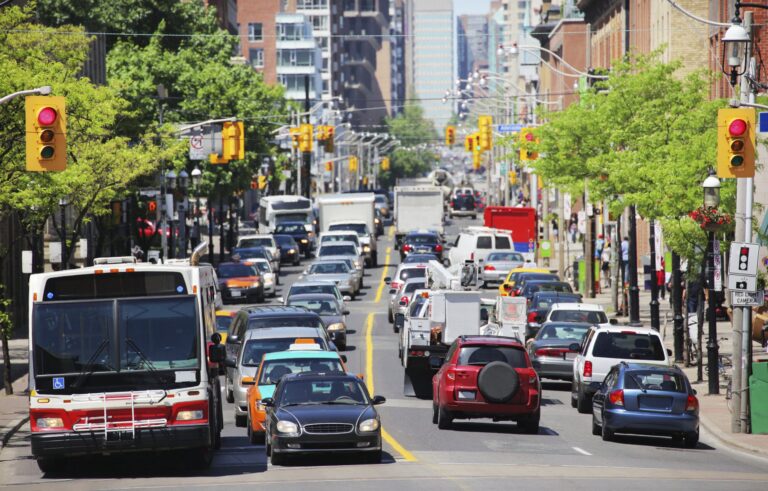
Post-secondary institutions often face congestion in and around campus with vehicles coming in at all hours. Not only does congestion have an economic cost on productivity due to sitting in traffic and not working for faculty and staff, but it also has a major impact on student performance. Students who face congestion are less motivated to attend class, which can affect their grades and academic performance.
4. Increasing land values
Maintaining large parking facilities is costly, especially when there are sprawling surface lots. That precious land can be repurposed to provide more space for teaching, research, and learning. By reducing reliance on cars, institutions can reallocate resources for more impactful sustainability projects.
Institutions can still provide parking but by consolidating parking structures as it should be acknowledged that parking creates a revenue source for institutions. Technology and pricing policies can ensure that revenue generation is preserved while also encouraging fewer cars on campus. For example, institutions can utilize dynamic pricing for parking to incentivize less driving to/from campus. Based on past parking patterns, pricing can be used to maximize revenue while minimizing unwanted behaviour. Technology can also help to maximize existing parking lots, such as using tandem parking spots.
5. Attracting Students and Reducing Cost of Living
Driving alone is the most expensive form of getting around. Offering sustainable alternatives not only helps to greatly reduce the cost of attending school but also means that students have leftover money to afford a meal. Research has shown that over half of post-secondary students in Canada are food insecure.
The cost of living is a major factor in deciding where to go to school. Besides the cost of housing, transportation and getting around contribute to this important decision. Institutions may not always be able to easily address housing costs, but they can do much easier with sustainable transportation.
Leadership Matters: York University’s Example
York University is a standout example of what leadership in sustainable transportation looks like in Canada. As a member of the Smart Commute program, York U has demonstrated a strong, ongoing commitment to reducing single-occupancy vehicle use and promoting sustainable commuting options for its students, staff, and faculty. In 2024, York University became the first university in Canada to receive the Best Workplaces for Commuters (BWC) designation, a milestone that reflects years of investment in active and public transportation infrastructure, commuter benefits, and behaviour change programs.
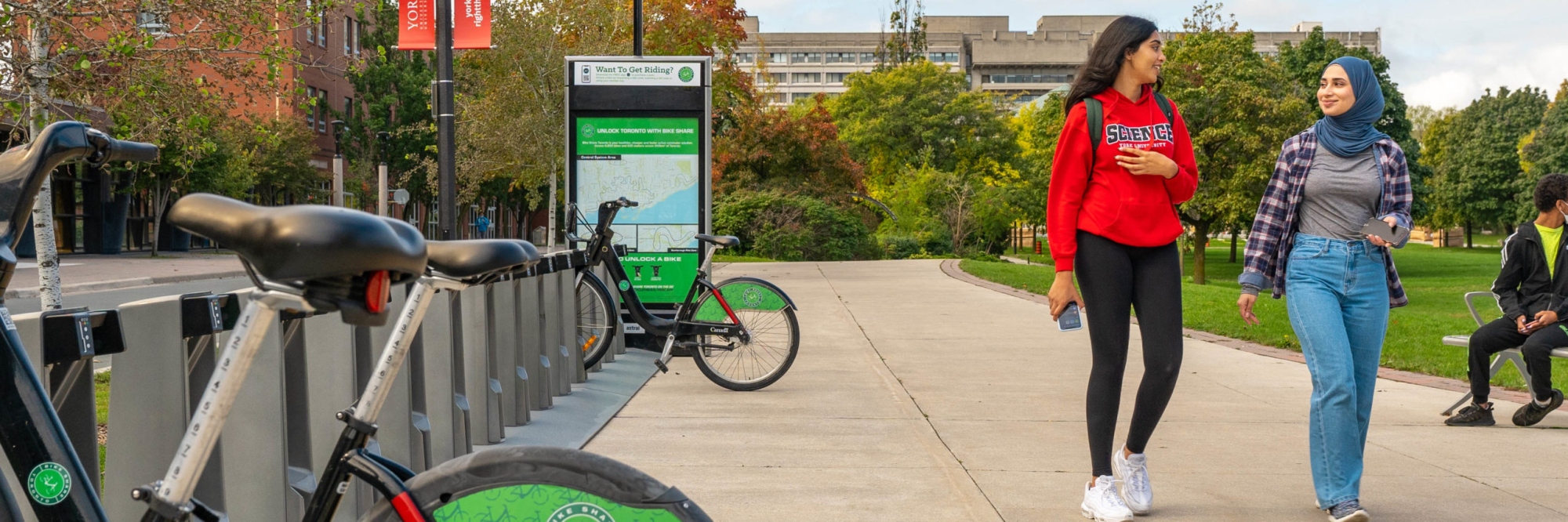
Through a robust set of initiatives including discounted transit passes, secure bike parking, trip planning tools, carpool matching, and on-campus amenities that support sustainable commuting, York U has created a campus environment that supports low-carbon travel. Their efforts benefit not just the university community but also contribute to regional goals around congestion reduction and air quality improvement.
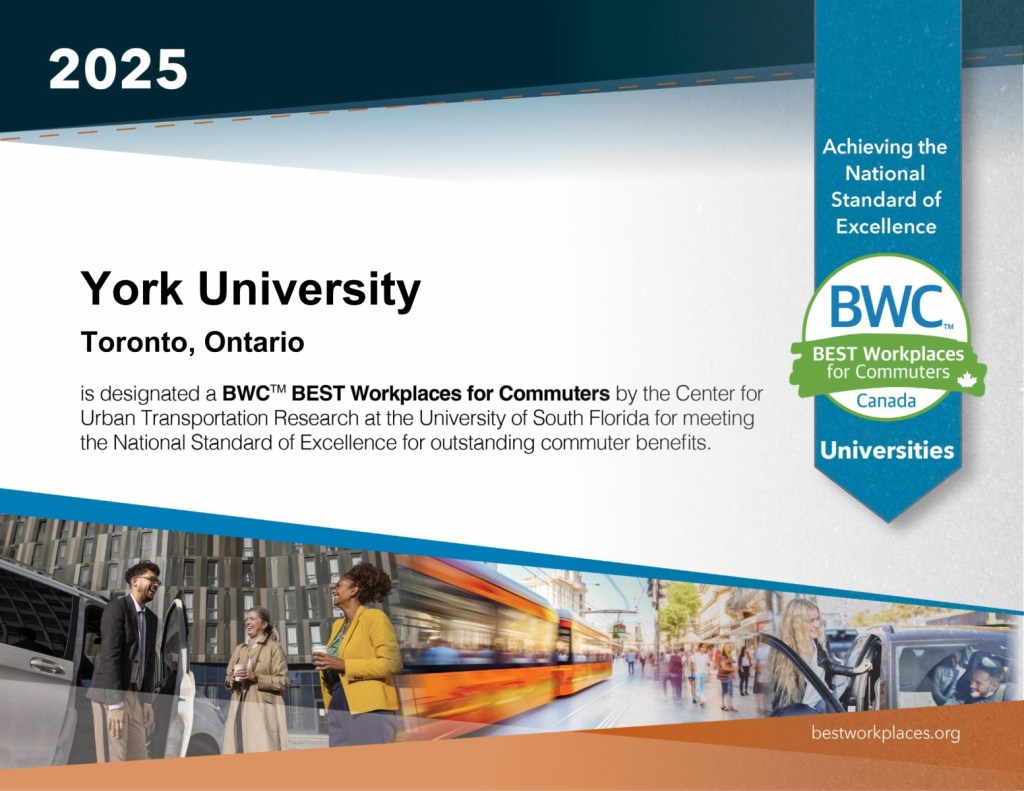
York’s leadership sends a powerful message: post-secondary institutions can make sustainable transportation a priority and drive change that extends far beyond their campus borders. Their BWC designation affirms that these actions are not only effective; they’re also worth celebrating and replicating. Read about their success story here.
In the U.S., some of the most well-known In the U.S., some of the most well-known institutions such as Stanford, Yale, Harvard, University of California, and Florida State have joined the BWC list. As Canada continues to lead in higher education and sustainability, there’s an opportunity to catch up in this space.
As the Clean Air Partnership notes in its recent report, Empowering Change: How Institutions Can Play a Key Role in Advancing Sustainable Mobility, colleges and universities can serve as catalysts for community-wide transformation. With their size, reach, and resources, they have the potential to shape broader commuting patterns and inspire systemic change.
Become a BWC campus today
Canadian post-secondary institutions are already doing impressive work to support sustainable transportation. And we recognize that they are doing so in challenging economic times. The next step? Getting recognized for it. The BWC designation offers not just a badge of honour but a platform to share success stories, attract sustainability-minded students, and demonstrate leadership in climate action.
Let’s make 2026 the year that more Canadian campuses claim their spot on the list!
pointA’s sustainable transportation experts are here to help with programming and to get help you get the recognition you deserve, book a call and let’s talk about how you can achieve the BWC designation.