

Written by Amélie Chanda, Program Manager pointA
Montréal is a city full of life, culture and an incredible food scene and getting around sustainably is easier than you might think. Whether you are commuting to work, heading to a museum or wanting to explore a new restaurant, the city’s transit system, operated by the Société de transport de Montréal (STM), makes it simple to get from point A to B.
At the heart of it all is Montréal’s fast, reliable and easy-to-navigate subway system. The Metro also connects seamlessly to buses, commuter trains, and bike-sharing options, opening endless options for getting around this vibrant city.
In this guide, we will break down the basics for using the Metro and the bus networks as well as options to get you out further. We’ll talk about payments and about how to get your bike on transit as well as some tips for making your commute a smooth and stress-free experience.
Understanding the Metro System
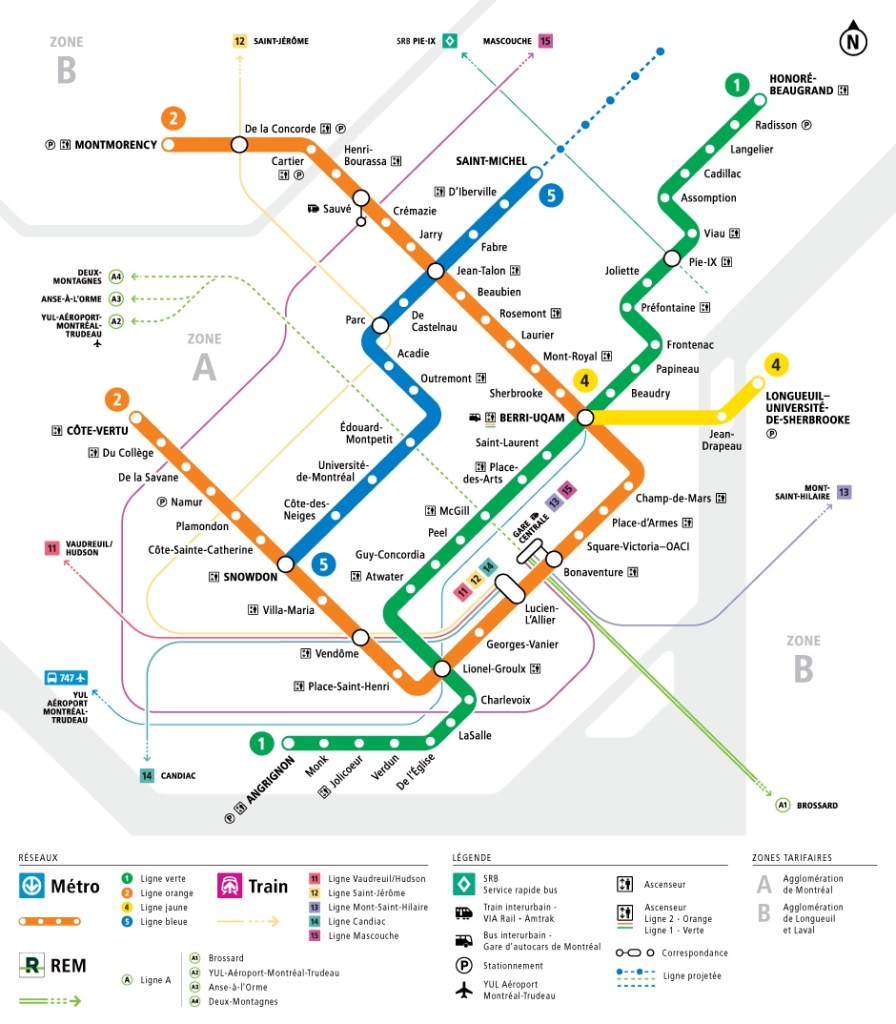
With four colour-coded lines servicing the downtown core and extending into areas like Lasalle, Laval, and even the South Shore via connecting bus routes, the metro makes it easy to travel quickly and efficiently across the island.
A single ride costs $3.75 and includes one free transfer to a bus. While there are no additional fares required to transfer between Metro lines, you should keep in mind that once you exit the Metro system, you’ll need to pay again to re-enter. If you plan on making multiple trips in a day, check out the 24-hr unlimited pass for $11.00 or the weekend unlimited pass for $16.75.
Trains begin running at 5:30am daily and run until 1:00am on weeknights and until 1:30am on weekends. During peak hours, service is frequent, with trains arriving every 3-5 minutes to ensure speedy transit to your destination.
Compared to other big cities, Montréal’s Metro stations have minimal gaps between the platform and train, making boarding smoother for everyone. However, not all stations are wheelchair/ stroller accessible. Many older stations still rely on stairs, so be sure to check the Metro map, which clearly marks accessible stations.
Exploring Further with the Bus

While the Metro is fast and easy to zip around central Montréal, the bus network can take you much further, making it the best option to reach places like the airport, the West Island or more distant neighborhoods.
Montréal’s local buses operate every day of the week, 24-hours a day, making them a reliable choice even after the Metro shuts down at 1:00am (1:30am on weekends).
Wait times for buses can vary, especially depending on the time of day and weather conditions. In the winter months, delays are common especially after heavy snowfall so it’s a good idea to check schedules and plan ahead. Expect to wait anywhere from 5 to 30 mins for a bus with shorter intervals during peak hours.
In terms of payment, fares are the same as Metro ($3.75 per ride), but you will need to pay with exact change or use a pre-purchased ticket or pass to get on. A great safety feature with the buses is that if you are travelling alone late at night, you can ask the driver to let you off between stops as needed.
Payment Methods
Montréal transit fares work seamlessly across Metro and bus systems, and there are a few easy ways to pay. You can purchase a single ticket (for $3.75) or a reloadable OPUS fare card (for $6) at any Metro station or participating depanneurs (corner stores). Metro station kiosks accept cash and credit cards while buses only accept exact cash with no change given. Keep in mind, debit or credit cards are not accepted on buses.
STM also offers discounted fares to students, seniors aged 65 and older, as well as children under 11 when accompanied by an adult. For the most up-to-date fare pricing and offers, click here.
Commuting Tips
To help you improve your transit experience, the STM suggests using the Chrono and Transit App. Both apps offer real-time bus and metro schedules, trip planners, and map displays. Chrono also lets you check the balance of your fare card and reload it when required.
To stay alert on disruptions, delays and service changes, you can follow STM’s social media or subscribe to My Alerts for SMS/email updates. For commuting safety, you can text STM to report an issue.
Other Transit Options
Looking beyond the Metro and bus? Montréal offers plenty of alternatives to get around.
- 747 Airport Shuttle: For $11.25, the two-way 747 bus takes you directly from the YUL Montréal-Trudeau airport to all metro stations between Lionel-Groulx and Berri-UQAM, then stops at Montreal’s downtown bus terminal (Gare d’autocars de Montréal).
- BIXI Bike Share: With over 12,600 bikes and 1000 stations across the island, BIXI is a great option for those who want to explore the city by bike. You can choose to pay as you go or purchase a monthly membership depending on your needs.
- Exo Commuter Trains: Ideal for commuters from places like Mont-St-Hilaire or Vaudreuil, Exo operates five train lines that connect the downtown core to the surrounding suburbs.
Bringing Your Bike on Transit
Planning to combine biking with public transit? The STM makes it easy with a few simple rules to follow. You can bring your bike on the Metro (except during some major events) as well as on 8 bus routes.
Make sure to review the instructions for loading and removing your bike ahead of time.
Montréal’s transit system is one of the easiest and most efficient ways to explore the city. With a reliable Metro, an extensive bus network, and plenty of alternative options like BIXI bikes and commuter trains, getting from place to place has never been easier. Bon voyage!
Photo Credits:
- https://unsplash.com/photos/a-blue-and-white-bus-driving-down-a-street-at-night-PVnnYXQ93VQ
- https://www.stm.info/sites/default/files/media/Stminfo/images/a-plan-metro-blanc.pdf