
Written by Dorinda So, Executive Director and Helene Kwong, Acting Marketing and Communications Manager
The Toronto Transit Commission (TTC) announced that monthly fare capping will begin on September 1, 2026. This would remove monthly transit passes and instead, rides would become free after 47 paid trips per month. This is being introduced at an opportune time, as many companies are implementing return-to-office mandates.
The Basics
Here are the main things to remember when it comes to monthly fare capping:
- The Adult 12-Month Passes (for $143.00) and TTC Post-Secondary Monthly Passes ($128.15) remain the best value for money. For other fare types, monthly fare capping is better value than the discontinued monthly passes.
- A paid trip is the first tap that starts your 2-hour transfer period.
- Transfers do not count as an additional “paid trip.”
- Transfers do not count as an additional “paid trip.”
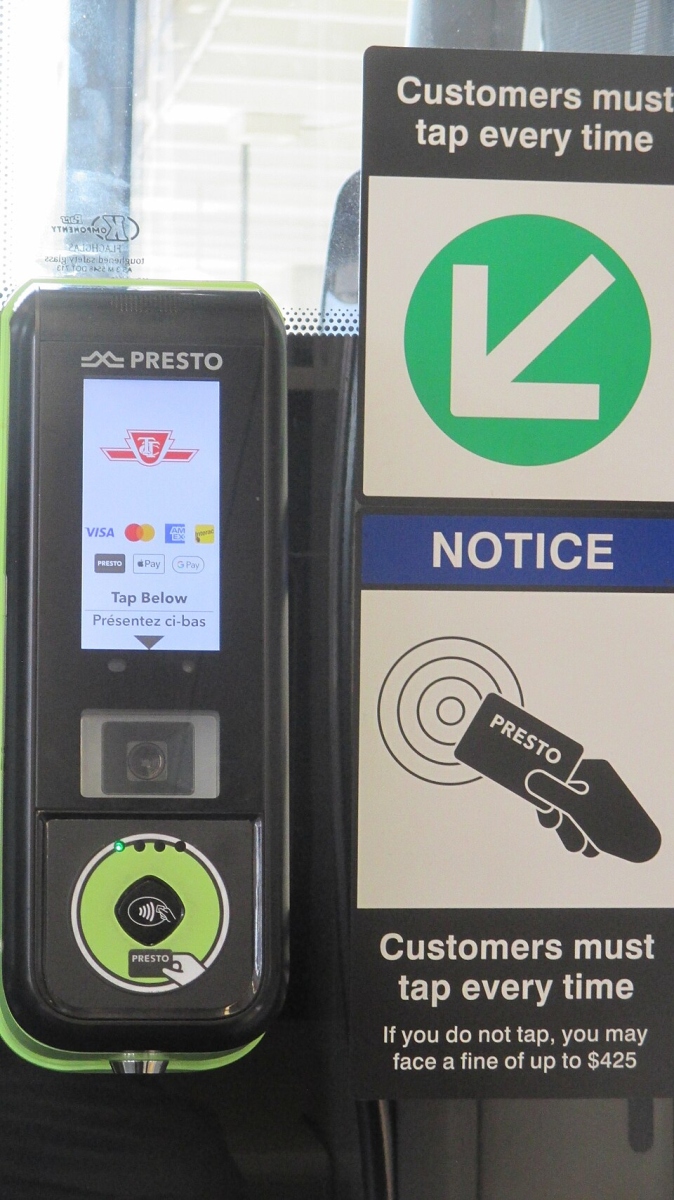
- Monthly fare capping is available when you tap to pay with:
- a PRESTO card (physical or from a mobile wallet)
- an Interac® debit card (physical or from a mobile wallet)
- an Interac® credit card (physical or from a mobile wallet)
- Use the same payment method for the whole calendar month.
- E.g., if you started by paying your fare with a physical debit card, only use that card to pay for the rest of the month.
- E.g., if you started by paying your fare with a physical debit card, only use that card to pay for the rest of the month.
- Continue to tap on and off every time. After 47 paid trips, your rides will automatically be free but tapping is needed to capture your Proof-of-Payment.
- On your 48th paid trip, the card reader will read “$0” when you tap for the rest of the month. If you’re using a PRESTO card (physical or in mobile wallet), you can check the number of trips taken through the PRESTO app.
Where It’s Been Done
Fare capping has been long used by other agencies. As of 2024, 15% of all North American transit agencies offered fare capping, according to the American Public Transportation Association. In Canada, York Region Transit introduced this program in 2024. This along with the many improvements they have made, increased ridership by 12% in 2024 from 2023. Brampton Transit markets this program as a loyalty program that rewards Presto users after 12 trips in a week. GO Transit also has a similar program at 41 rides per month. OC Transpo in Ottawa also recently started offering this as well. Edmonton Transit (ETS) has a more complicated fare capping system based on location, distance, and type of fare, with daily and monthly caps. It should be noted that fare capping is only available to those using smart cards, such as Presto or Arc for transit.
Why It Works
There are a number of reasons why fare capping is effective:
- For most fare types, it ends up being cheaper than the old monthly TTC pass. If you’re a resident enrolled in the Fair Pass Transit Discount Program and paying with a PRESTO card, it’s $2.10 per ride. With monthly fare capping, you would be riding for free after paying $98.70 for 47 rides. This is cheaper than the discontinued Fair Pass Monthly Pass ($123.15).
- Fare capping allows users to pay per use, instead of paying upfront for a full month’s transit, which is particularly beneficial for lower income individuals, maximizing accessibility. Moreover, this flexibility is helpful to most if not all riders. For example, if a rider is on vacation, taking leave from work, or any circumstance arises when their transit usage may be lower than usual, they do not have to worry about their monthly pass.
- Riders do not have to count rides to ensure that they meet the minimum number to reap the benefit of using a monthly pass. On average, across Canadian transit agencies, this takes 33 trips, which if commuting to/from work every weekday would mean that it would take more than 3 weeks for this to happen.
- Fare capping applies to people paying with an Interac® credit card, but using a smart card, such as Presto or Arc, can help to reduce credit card swipe fees, especially for those who pay single fares using their credit cards.
- Fare capping is a way to “reward” loyalty and increase ridership. In fact, the TTC estimates that ridership may increase from 3.6 million if capped at 47 rides, contributing a 0.8% to 4% increase in ridership. This is significant considering that 2024 saw a 6% increase in ridership from 2023.
It should be noted that the ridership comes at a cost and the TTC expects a revenue loss from this scheme, which it expects to offset through an overall increase in fares. The TTC’s 2026-28 Ridership Growth Strategy report proposed a levy on ride hailing trips. This is because a City of Toronto 2024 report found that a majority of ride hailing (Uber/Lyft) services compete with transit.
What Employers Need to Know
For employers who offer transit passes for their employees, which are currently tax exempt for the employee, they must now change how they purchase their monthly passes. Employers have the following options:
- Purchase vouchers if the program is available, depending on the transit agency, and send them out on a monthly basis to employees;
- Reimburse employees for their monthly commuting spend;
- Provide a transportation stipend or subsidy for employees using public transit and include this on their paystubs.
Note: While the first two options remain non-taxable benefits, the last option may be taxable for employees and must be included in employee T4s.
Overall, fare capping is a great way to reward usage and achieve multiple goals for transit agencies. It also maximizes accessibility, which is great for everyone.
Get Commuter Benefits
Need help setting up your employee commute incentives? Our team can help you figure out the best solution for your team and work with you on setting this up. As an employer, if you are already offering transit passes or subsidies to employees, you could be eligible for our Best Workplaces for Commuters (BWC) designation. Book a free consultation with one of our team members to learn more.
Photo Credits:
https://commons.wikimedia.org/wiki/File:Presto_reader_supporting_open_payment.jpg