

Written by Amélie Chanda, Program Manager, pointA
Many organizations track and report their emissions using the GHG Protocol Scope 1 to 3 method. This not only adheres to the growing global movement of formally reporting on these emissions but recognizes that climate risks can significantly impact business operations and supply chains.
While Scope 1 and 2 emissions are mandatory to report, employee commuting emissions are part of Scope 3, which is voluntary and can make up to 70% of an organization’s emissions. And once those emissions are captured, how do you reduce it?
At pointA, we help organizations gather and interpret commuter data to design programs that can make a real difference, measuring and then designing programs to reduce emissions in a tangible way. To do this, we start by working with organizations to understand their commuter patterns to determine the emissions baseline and identify gaps through a comprehensive commuter assessment and then, create targeted programs.
As not all data is equally useful, quality data is key to making informed decisions.
Here are the three categories of data that we find most helpful:
- Time: How long do employees spend commuting? Commute time directly impacts employee productivity, satisfaction, and retention. This data can help identify programing opportunities.
- Cost: How much do employees spend on commuting? The financial cost of commuting can be steep for some considering gas, parking, vehicle maintenance or transit fair. Getting a breakdown on cost can help shape programing.
- Carbon: How much CO₂ do employees emit while commuting? Commuting emissions can contribute significantly to the organization’s Scope 3 emissions. Tracking these emissions provides a baseline and helps organizations set measurable sustainability goals.
Collecting commuter data is about uncovering real opportunities for change. With the right insights, we can help our clients confidently answer key questions:
- What kinds of programs do employees need?
- Where can resources be invested for maximum impact?
- How can commuting programs align with strategic goals?
Two Approaches to Gaining Commuter Insights
The next step is to determine how to collect the data. We have two main approaches: a survey-based commuter assessment or a technology-driven solution using a platform like Commutifi Compass. Each method provides valuable insights, but the right choice depends on the organization’s priorities, resources, and data needs.
Approach 1: Survey-based Commuter Assessment
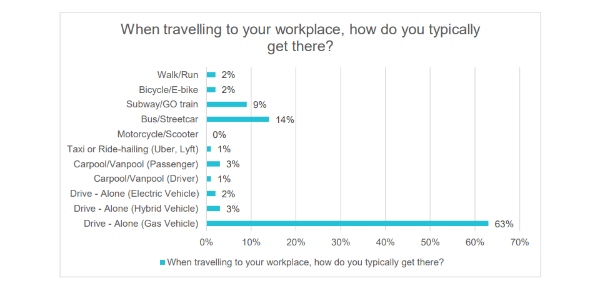
For organizations looking for a structured, yet hands-on approach, a Commuter Assessment provides direct engagement with employees to gather valuable insights. The method involves:
- Surveys to understand how employees commuting patterns.
- Data analysis to identify opportunities for sustainable commuting programs.
- pointA will produce a report with valuable insights that will drive programming options to reduce emissions.
Great for:
- Organizations that are reporting every 1-3 years.
- Property managers that have to manage a number of different companies with different email addresses.
- Organizations that want some baseline data and measurement before committing to more technology.
- Employees who don’t have email addresses or don’t want to create accounts to access technology
Approach 2: Technology-Driven Integration with Commutifi
For organizations that prioritize efficiency and data-driven decisions, we support the procurement of Commutifi, an advanced technology platform that automates commuter data collection and analysis. This approach offers:
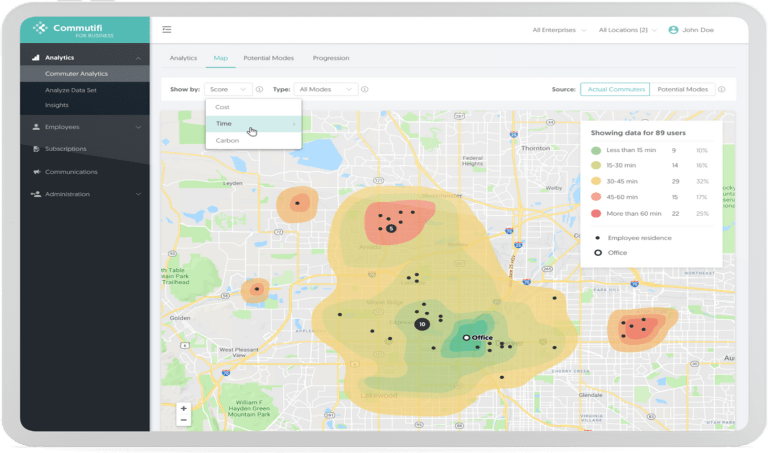
- A fast and scalable way to assess commuter patterns: The commuter assessment takes very little time to complete and the results for each employee are instant.
- Granular insights on travel time, cost and carbon emissions including heat maps and other visualizations.
- Integrations into a program management tool that Commutifi offers and pointA manages so that insights and reductions are directly captured by the technology and reports are automatically generated.
pointA’s role goes beyond technology procurement;, we help organizations interpret the data and develop programming recommendations based on the insights gathered.
Great for:
- Organizations who want regular reporting, such as seasonal updates when commuting patterns change.
- Single sign-on (SSO) approach and security using an employee’s email address as login.
- Organizations who want to take advantage of platform technologies that integrate everything commuting related on one platform that pointA can help manage, from carpooling to incentives, data reporting, and more.
Why does this matter?
Understanding commuter behaviour is key to building sustainable, effective, high impact commuter programs. Without quality data, organizations risk investing in initiatives that don’t address the real issues faced by their employees or drive meaningful change. The right insights provide a roadmap for strong programming, smart resource allocation and measurable progress towards organizational goals.
At pointA, we help organizations of all sizes gather, make sense of their commuting data and turn insights into action. Whether you are just starting to explore commuting programs or looking for a more advanced, data-driven approach, we guide you in choosing the best path forward.
Both approaches require investment to drive uptake.
Why work with pointA
We know that many businesses can deploy their own assessments. But once you have the data, what do you do? How do you work to reduce emissions, resolve issues, and help employees save money? pointA has over 20 years of experience to help you do all of that and design effective programs that are targeted and can help support employee commuting over time.
Let’s chat! Use this link to book a free discovery call to discuss how we can help your organization gather the right insights and build commuter program that works for you!